Thursday, October 22, 2009


Thursday, August 20, 2009
Fun in Finland - 6 Degrees Below

Think Finland and what you associate it with depends on the time of day. During office hours, your mind could throw up Nokia, which is one of Finland’s best known products. Whereas if you’re hanging and mellow after hours then maybe a wistful smile will spread on your face as you associate the country with its other best known - and dare I say better loved – product that is Finlandia Vodka.
Whatever you associate to this Scandinavian country sandwiched between Sweden and Russia and flanked by the Baltics, its capital Helsinki will welcome you with opulent grandeur.

Fine restaurants, boutique hotels and some of the best night life in Scandinavia make this city pulse with energy and emanate with a lively vibe. But the city also keeps in touch with its past that is why tram lines are crisscrossed with the coolest European cars and old world cobbled streets are tread on with designer shoes.
Senate Square is the epicentre of Helsinki’s tourist trail. Packed with buskers and food stalls during summer and overlooked by the Tuomiokirkko Lutheran Cathedral and the articulately sculpted statue of Tsar Alexander II of Russia.
Alexander II took steps to increase Finland’s autonomy from Russia and was honoured by this statue in 1894. His grandson Tsar Nicholas II once again ‘Russified’ Finland and the people of Helsinki used to leave flowers at the base of this statue of ‘the good Tsar’ in a sort of quiet protest to the decrees of his grandson. Even today once in a while the stray bouquet turns up.
Besides that there are sights like the Temppeliaukio Church which is cut into granite rock and topped with a skylight roof and the Uspenski Cathedral.
But Finland doesn’t begin and end with Helsinki. In the north of the country is Rovaniemi which is a playground for those who seek adventure and want to have a tete a tete with Santa Claus.

That is right. Santa is here, right here in the heart of Rovaniemi.
Rovaniemi is an hour’s flight north from Helsinki and is the administrative capital of Finland’s Lapland province. Since the Arctic circle line passes through the town you can imagine that winters can go down to -40 degrees C.
While I was in Rovaniemi there yet was snow on the ground and ice on the rivers and lakes, but the locals had a bounce in their step. The sun had popped over the horizon after months of darkness and birds were already singing. Soon spring would give way to summer, the snow would melt, flowers would bloom and the temperature would rise.
But right now we could use the frozen river as a highway.
The next morning it was a beautiful day with the sun shining in a deep blue sky with a few scattered clouds. The Kemijoki River was frozen solid and the landscape was still mostly white. Our guide led us towards our transportation which consisted of spanking new snowmobiles ideal for travelling over snow laden paths and frozen waterways.
Today we were heading towards Santa’s Village to meet jolly old Father Christmas.
Santa’s office is a merry place with kids running around happy after having sat on Santa’s knee. Giant jolly snowmen flanked the entrance of his main office. Next door at Santa’s main post office Santa’s elves were busy at work diligently replying to every letter that Santa received.
And these are a lot because Santa is so popular. And his popularity shows because there are always tourists (mainly children) waiting to meet him. Santa’s inner study is a warm haven with an antique phone, bookshelves with leather bound books and is warm as toast. And of course there is Santa Claus who looks every bit the part.
Children (and even adults) can have their pictures taken with Santa and then buy prints of the same (at a high price of course). You can also have an entire DVD with live footage of your interaction with Father Christmas.
That was all very good, but what set my pulse racing were the snowmobile safaris.
Skidoos, as snowmobiles are affectionately called, are like riding a motorcycle but without having to balance. They are driven from behind and the skis ahead can be steered using the handlebars.

The highlight of my visit to the Arctic Circle were these exploratory rides through the snowed out countryside and over frozen waterways.
On twilight rides bonfires were lit and hot berry juice was drunk during a break and sometimes an Arctic Fox was spotted.
Agreed that the temperature was perpetually hovering near the -10 degree mark and sometimes was even -2- degrees, but it was like a winter wonderland and I was revelling in it.

Monday, March 19, 2007
Destoying Diets - Tucking in Tasmania
 When I was checking in at Brisbane airport for my Qantas flight back home to Bombay. I apologetically told the chubby lady at the counter that I was overweight.
“So am I, sweetie. And I blame all our tasty food. You go ahead and have a nice flight!”
I’d of course been talking about my luggage, which she’d smoothly turned into a joke and graciously forgiven me for my 15kg excess.
But she wasn’t wrong about me being overweight. My ten days in Tassie were like one continuous food fest, a gourmet journey aimed at sampling all the islands gastronomical delights.

 Breakfast would tend towards bacon, eggs, sausages and waffles washed down with café latte topped with whipped cream. Lunch was invariably a wholesome meal in a country pub and that was served overflowing from the plate - mostly sausages and bacon mash, fish of the day or a pepper steak with chips and salad. In between breakfast and lunch we invariably stopped for brunch at some quaint village with a café famous for its hot buttered scones served with loads of fresh homemade jam or triple decked stuffed pancakes smothered with hot chocolate sauce and loaded with two scoops of ice cream and fresh cream. We’d prefer a fine dining restaurant for
  dinner for the
 ir quiet ambience ideal for relaxing over a meal at the end of a hectic day. Here there was as much emphasis on the visual appeal of the serving as on its taste, quantity was somewhat sidelined. And in between these four meals we’d snack a little here and there on
  Tasmanian pies, sausage and mustard rolls, pastries and ice creams and taste various cheese, chocolates and salmon at dairies, factories and farms. Added to that was our liquid diet of flavoured milk, fine wines and full bodied beers. So yes, by the time I was ready to return it was becoming quite a fight to button up my jeans.
 Sonamarg
Patseo Phiang was positively peeved!
The hardy Mongol had been compelled to take the route through Ladakh this summer of 1603 because he’d been commanded by his chieftain to transport some monks to the Lamaruyu monastery en route. He and his caravan usually took the route through northern China on their way to Central Europe. He knew that there was no point in losing his head with his chief because by arguing with him he would have ended up literally losing his head.
Besides that, the dozen double-humped Bactrian camels he thought he’d bought for a steal from the local tribesmen in the Nubra Valley, were most happily munching through his livestock fodder at an astonishingly rapid rate, and he hadn’t found any buyers yet. But more than all this, it was his bunch of 57 merry wives that were totally ticking him off. He’d chosen 14 of the youngest and nubile ones to take along and keep him company on those long cold nights. But his older wives, matronly and imposing had insisted on coming – it was a long and dangerous journey to the Barvarian Kingdom in Central Europe and should anything happen to the Patseo they didn’t want the young wives getting their hands on his fortune. And now every morning when it came to breaking camp and moving on old Phiang fretted and fumed as the wives inevitably got on the move 6 hours later than the ETD (expected time of departure).
He should have been in Istanbul by now and yet he was here standing on the summit of Zoji La as his vivacious mates cackled and gossiped as they finally started the days journey. Phiang cast a nervous glance at the huge cliffs of snow that hung above them, half scared that their high pitched voices might start an avalanche and half hoping that one would occur and bury all 57 of them and conveniently cut out this cacophonic concert once and for all.
So yes, Patseo Phiang was quite pissed off while he was descending from Zoji La, when, suddenly he rounded a corner of the cobbled road and his anger and bitterness dissipated into joy and pleasure. His heart skipped a beat as he shielded his eyes and looked heavenwards almost worried that his day of reckoning has come, how else could he explain the overbearing beauty he had just gazed at? He galloped back and asked his wives to hurry up and see what he had, surprising them because this was the first time in many days that they’d seen the laughter reach his eyes.
Patseo Phiang had just seen Sonamarg – the eastern gateway to Kashmir.
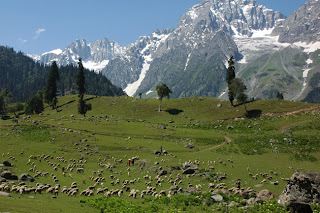 Four hundred years later, similar emotions had rushed through me when I stood at the very same place looking down upon Sonmarg. But of course I didn’t have a harrowing harem following me, nor was I plagued by constantly consuming camels, my troubles were restricted to trepidation and fatigue. I’d been riding my bike for over 7 hours, through the night, alone, on those stark and desolate mountain roads between Kargil and Zojila. The sharp rocks I’d ridden over were very capable of blowing my tyres out, and that had fuelled my fear. Also, I was weary with the effort of swinging around the heavily loaded bike, trying to avoid the worst of them. All along the line of control the constant crash and boom of enemy guns had jarred my head.
But the sight of Sonmarg simply sorted me out. With its rolling green meadows, pine forested gentle slopes giving way to lofty white caps, this oft ignored little hamlet of Kashmir was my first welcome to India’s prettiest state. And though I’ve been to Kashmir many times since, it is that dawn view of Sonmarg from high above that flashes in my mind whenever I think of Kashmir.
The hardy Mongol had been compelled to take the route through Ladakh this summer of 1603 because he’d been commanded by his chieftain to transport some monks to the Lamaruyu monastery en route. He and his caravan usually took the route through northern China on their way to Central Europe. He knew that there was no point in losing his head with his chief because by arguing with him he would have ended up literally losing his head.
Besides that, the dozen double-humped Bactrian camels he thought he’d bought for a steal from the local tribesmen in the Nubra Valley, were most happily munching through his livestock fodder at an astonishingly rapid rate, and he hadn’t found any buyers yet. But more than all this, it was his bunch of 57 merry wives that were totally ticking him off. He’d chosen 14 of the youngest and nubile ones to take along and keep him company on those long cold nights. But his older wives, matronly and imposing had insisted on coming – it was a long and dangerous journey to the Barvarian Kingdom in Central Europe and should anything happen to the Patseo they didn’t want the young wives getting their hands on his fortune. And now every morning when it came to breaking camp and moving on old Phiang fretted and fumed as the wives inevitably got on the move 6 hours later than the ETD (expected time of departure).
He should have been in Istanbul by now and yet he was here standing on the summit of Zoji La as his vivacious mates cackled and gossiped as they finally started the days journey. Phiang cast a nervous glance at the huge cliffs of snow that hung above them, half scared that their high pitched voices might start an avalanche and half hoping that one would occur and bury all 57 of them and conveniently cut out this cacophonic concert once and for all.
So yes, Patseo Phiang was quite pissed off while he was descending from Zoji La, when, suddenly he rounded a corner of the cobbled road and his anger and bitterness dissipated into joy and pleasure. His heart skipped a beat as he shielded his eyes and looked heavenwards almost worried that his day of reckoning has come, how else could he explain the overbearing beauty he had just gazed at? He galloped back and asked his wives to hurry up and see what he had, surprising them because this was the first time in many days that they’d seen the laughter reach his eyes.
Patseo Phiang had just seen Sonamarg – the eastern gateway to Kashmir.
Four hundred years later, similar emotions had rushed through me when I stood at the very same place looking down upon Sonmarg. But of course I didn’t have a harrowing harem following me, nor was I plagued by constantly consuming camels, my troubles were restricted to trepidation and fatigue. I’d been riding my bike for over 7 hours, through the night, alone, on those stark and desolate mountain roads between Kargil and Zojila. The sharp rocks I’d ridden over were very capable of blowing my tyres out, and that had fuelled my fear. Also, I was weary with the effort of swinging around the heavily loaded bike, trying to avoid the worst of them. All along the line of control the constant crash and boom of enemy guns had jarred my head.But the sight of Sonmarg simply sorted me out. With its rolling green meadows, pine forested gentle slopes giving way to lofty white caps, this oft ignored little hamlet of Kashmir was my first welcome to India’s prettiest state. And though I’ve been to Kashmir many times since, it is that dawn view of Sonmarg from high above that flashes in my mind whenever I think of Kashmir.
Sunday, March 18, 2007
Where the Ice meets the Sky

So we’ve all seen mountaineering expeditions on the National Geographic and Discovery channels. Human beings fighting hard against the enormity of nature and revelling in the huge personal challenge to overcome the cold and forge on over ice and snow across terrain that is breathtakingly beautiful and at the same time terrifyingly treacherous. And lounging comfortably in front of my telly snug and cozy I would often think – I would like to give this kind of adventure a go. But, to get to walking on fields of ice and glaciers, one would have to be a keen mountaineer, have the stamina and the resources to partake in a trek that would already be in its 3rd or 4th day before it reached the snowline.
But in New Zealand I had my opportunity to go ice hiking, without the rigmarole of a long trek, or the necessity to climb a couple of thousand meters.
This was thanks to a glacier called the Franz Josef.
New Zealand’s south Island has a mountain chain called the Southern Alps that have been formed by the collision of two of the earth’s major seismic plates. The eastern (Pacific) and the western (Australian) plates are currently grinding together along a fault that runs diagonally through the South Island pushing up the land to form the Southern Alps.
Right, so thanks for the geography lesson but what has this to do with walking on ice.
Everything! These Southern Alps stop the moisture laden winds called the roaring forties and they precipitate into snow and ice high on the mountain tops. Thanks to the topography of the mountains, of the 140 or so glaciers high above, two reach right down into the rain forests. One of them is the Franz Josef Glacier. This glacier has spawned a village named after it and now this 21km long fast moving and slow melting tongue of ice is quite literally enjoying its place in the sun as all activities around this village are focussed on this glacier.
And so this May I had my chance to play Edmund Hillary. Though guided tours on this glacier started way back in 1903, these involved an arduous hike through the rainforest and some serious climbing before getting onto the glacier. Today helicopters have changed all that.
A beautiful day greeted me when I threw open the curtains of my bed room at the Holly Homestead, a charming B & B just outside the village and at 10.15am I reported to the Helicopter Line office. The plan was quite simple. Get into a helicopter, fly around taking in gorgeous views of the glacier and the Pacific Ocean and then get dropped off on the glacier itself for a two hour hike before being picked up again. This activity is unique to the Franz Josef glacier because it reaches so far down from the mountains. Anywhere else in the world for an activity like this you’d have to go at least 10,000 feet high and then too you’d have to be properly acclimatised to the height. Here we’d be at just 800 feet above sea level and walking on ice.
The exercise started off with everyone’s weight and shoe sizes being taken. Like everyone else I was dressed in 4 layers of warm clothing and comfortable walking pants. With tons of ice around you, it does get chilly even in bright sunlight.
 Next we were handed part of our equipment, which comprised of sturdy walking boots and a waist pouch which contains steel crampons which we would have to strap on to the shoes once on the ice.
The helicopter ride to the glacier gave me my first perspective of the enormity of this ice mass. It looks like a narrow strip of smooth snow from the village but as we flew in over it I saw that its surface was made up of little hillocks and crevasses of ice. The pilot expertly banked the chopper against the imposing mountainsides and neatly landed on a flattened small circular patch of ice that served as the glacial helipad. The moment we stepped out of the chopper all 8 of us became spontaneous contortionists. Solid ice and rubber soles don’t exactly agree about grip and we realised the best thing to do was standstill and try to strap on the crampons without any jerky movements.
With the crampons on, the ice lost its slippery edge and the metal crampons dug into it to provide a comforting grip. Guiding us that morning was Gabriel, hugely experienced in ice craft; he gave us an interesting briefing on the techniques we needed to use in negotiating our way across the glacier. First off he told us to always keep our feet well apart, because if both the crampons came together, there was a chance they might lock up and we’d fall flat on our faces. Secondly he told us how to negotiate steep ice slopes and finally he explained the right way to use our ice axes.
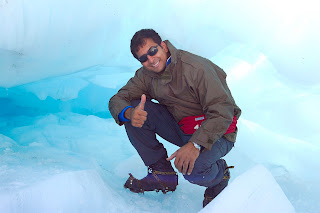
The briefing done, we set off in a single file. At places where the slopes were too steep, Gabriel would hack out makeshift steps in the ice to make it easier for us. Walking along that glacier I realized that even though it was just frozen ice, the surface had such varying features. There were ice caves, crevasses, narrow gullys and ridges. There were also narrow passageways formed by the centre of huge block of ice melting away and we had to squeeze through these sideways. And, in such close proximity with huge chunks of ice you could actually feel the warmth being sucked away from your body neve mind the four layers of clothing and the fleece.
Gabriel made the walk interesting by feeding us riveting bits of information regarding the creation and movement of the glacier. He explained that if we looked around, we’d realize that the ice had a blueish tint. This is due to the Rayleigh effect. Tiny air b ubbles and matter suspended in the ice scatter light in all directions. This scattering affects light of shorter wavelength more that that of longer wavelength and that’s why the short wavelength blue – violet light is refracted back first. Besides this, it was a wonderfully clear day and the ink blue sky was also being reflected in little pools of water.
He also explained that the Franz is mainly an advancing glacier. It has retreated a few times but mainly it advances. This means that the snow fall high above is mostly more than the rate of melt and this pushes the glacier on towards the rainforests.
Ice walking needs to done with concentration and although we had Gabriel leading us through the safe paths, there were some places where the ice was really thin and this is exactly where you don’t want to put your foot. Also, since we were all walking in a single file, a ledge which was strong enough to take the first 4 walkers might start to become weak after the fifth one passed over it. So this certainly was not a walk in the park and every step had to be paid attention to, but then, this is what made it fantastically exciting. And by the time we finished our circuit and made our way back to the ice helipad all of us had got into the knack of things.
Once the crampons came off it was once again a little wiggly waggly walk short walk on the slippery ice pathway to the chopper which lifted off and put us down in the village in a short 7 minute flight.
So next time you watch mountaineers struggling on ice on telly, remember that there’s a charming little country called New Zealand in the south pacific which has a very obliging glacier called the Franz Josef that will give you all your ice hiking thrill without the effort and hardship that those poor guys on TV have gone through.
 [Franz Josef lies on the West coast of New Zealand go to www.west-coast.co.nz to find out more. There are plenty of hotels, motels and lodges. The one I stayed at was Holly Homestead. Run by a charming local couple who know the area very well. www.hollyhomestead.co.nz]
But in New Zealand I had my opportunity to go ice hiking, without the rigmarole of a long trek, or the necessity to climb a couple of thousand meters.
This was thanks to a glacier called the Franz Josef.
New Zealand’s south Island has a mountain chain called the Southern Alps that have been formed by the collision of two of the earth’s major seismic plates. The eastern (Pacific) and the western (Australian) plates are currently grinding together along a fault that runs diagonally through the South Island pushing up the land to form the Southern Alps.
Right, so thanks for the geography lesson but what has this to do with walking on ice.
Everything! These Southern Alps stop the moisture laden winds called the roaring forties and they precipitate into snow and ice high on the mountain tops. Thanks to the topography of the mountains, of the 140 or so glaciers high above, two reach right down into the rain forests. One of them is the Franz Josef Glacier.
 This glacier has spawned a village named after it and now this 21km long fast moving and slow melting tongue of ice is quite literally enjoying its place in the sun as all activities around this village are focussed on this glacier.
And so this May I had my chance to play Edmund Hillary. Though guided tours on this glacier started way back in 1903, these involved an arduous hike through the rainforest and some serious climbing before getting onto the glacier. Today helicopters have changed all that.
A beautiful day greeted me when I threw open the curtains of my bed room at the Holly Homestead, a charming B & B just outside the village and at 10.15am I reported to the Helicopter Line office. The plan was quite simple. Get into a helicopter, fly around taking in gorgeous views of the glacier and the Pacific Ocean and then get dropped off on the glacier itself for a two hour hike before being picked up again. This activity is unique to the Franz Josef glacier because it reaches so far down from the mountains. Anywhere else in the world for an activity like this you’d have to go at least 10,000 feet high and then too you’d have to be properly acclimatised to the height. Here we’d be at just 800 feet above sea level and walking on ice.
The exercise started off with everyone’s weight and shoe sizes being taken. Like everyone else I was dressed in 4 layers of warm clothing and comfortable walking pants. With tons of ice around you, it does get chilly even in bright sunlight.
 Next we were handed part of our equipment, which comprised of sturdy walking boots and a waist pouch which contains steel crampons which we would have to strap on to the shoes once on the ice.
The helicopter ride to the glacier gave me my first perspective of the enormity of this ice mass. It looks like a narrow strip of smooth snow from the village but as we flew in over it I saw that its surface was made up of little hillocks and crevasses of ice. The pilot expertly banked the chopper against the imposing mountainsides and neatly landed on a flattened small circular patch of ice that served as the glacial helipad. The moment we stepped out of the chopper all 8 of us became spontaneous contortionists. Solid ice and rubber soles don’t exactly agree about grip and we realised the best thing to do was standstill and try to strap on the crampons without any jerky movements.
With the crampons on, the ice lost its slippery edge and the metal crampons dug into it to provide a comforting grip. Guiding us that morning was Gabriel, hugely experienced in ice craft; he gave us an interesting briefing on the techniques we needed to use in negotiating our way across the glacier. First off he told us to always keep our feet well apart, because if both the crampons came together, there was a chance they might lock up and we’d fall flat on our faces. Secondly he told us how to negotiate steep ice slopes and finally he explained the right way to use our ice axes.

The briefing done, we set off in a single file. At places where the slopes were too steep, Gabriel would hack out makeshift steps in the ice to make it easier for us. Walking along that glacier I realized that even though it was just frozen ice, the surface had such varying features. There were ice caves, crevasses, narrow gullys and ridges. There were also narrow passageways formed by the centre of huge block of ice melting away and we had to squeeze through these sideways. And, in such close proximity with huge chunks of ice you could actually feel the warmth being sucked away from your body neve mind the four layers of clothing and the fleece.
Gabriel made the walk interesting by feeding us riveting bits of information regarding the creation and movement of the glacier. He explained that if we looked around, we’d realize that the ice had a blueish tint. This is due to the Rayleigh effect. Tiny air b
 ubbles and matter suspended in the ice scatter light in all directions. This scattering affects light of shorter wavelength more that that of longer wavelength and that’s why the short wavelength blue – violet light is refracted back first. Besides this, it was a wonderfully clear day and the ink blue sky was also being reflected in little pools of water.
He also explained that the Franz is mainly an advancing glacier. It has retreated a few times but mainly it advances. This means that the snow fall high above is mostly more than the rate of melt and this pushes the glacier on towards the rainforests.
Ice walking needs to done with concentration and although we had Gabriel leading us through the safe paths, there were some places where the ice was really thin and this is exactly where you don’t want to put your foot. Also, since we were all walking in a single file, a ledge which was strong enough to take the first 4 walkers might start to become weak after the fifth one passed over it. So this certainly was not a walk in the park and every step had to be paid attention to, but then, this is what made it fantastically exciting. And by the time we finished our circuit and made our way back to the ice helipad all of us had got into the knack of things.
Once the crampons came off it was once again a little wiggly waggly walk short walk on the slippery ice pathway to the chopper which lifted off and put us down in the village in a short 7 minute flight.
So next time you watch mountaineers struggling on ice on telly, remember that there’s a charming little country called New Zealand in the south pacific which has a very obliging glacier called the Franz Josef that will give you all your ice hiking thrill without the effort and hardship that those poor guys on TV have gone through.
 [Franz Josef lies on the West coast of New Zealand go to www.west-coast.co.nz to find out more. There are plenty of hotels, motels and lodges. The one I stayed at was Holly Homestead. Run by a charming local couple who know the area very well. www.hollyhomestead.co.nz]
Monday, January 29, 2007
RESPECT: Rajyams, FEAR: Yamraj
When I was 21 years old,
Typically rash stupid and bold,
I went through a phase called the double 'A'
My automotive adolescence so to say.
As a compromise between power and money,
I was given the Rajdoot Yamaha 350,
Yes, the one with the miserable fuel economy.
Though the four figure petrol bills, gave my wallet nasty chills,
The machine doled out amazing thrills.
The bike was built for mad, suicidal speed,
And that was my strongest need.
Under me, my Rajdoot Yamaha,
And the road was my virtual Suzuka.
You feel an incomparable high,
When on the road in harmony, you fly,
The bikes an extension of your body,
you two are one, You think about changing a gear and it's done.
Roaring into a corner you come,
The wind in your ears a loud hum.
Physics says you have to fall, and gravity does try,
But you make poor old Newton sigh,
He rolls over and over in his grave,
Wondering why, according to his laws you don't behave.
Your confidence soars, Louder the bike roars,
The throttle is like a baton in your hand,
The pistons and the crank, the best orchestra in the land.
And it is Wagners opera to your mind,
The sound of the engine screaming toward the red line.
The adrenaline in your blood makes it boil,
But, on the next corner there's spilt diesel oil…
Then comes the fall,
With a shower of sparks, bike, you and all.
You hit the tar at a hundred and one,
Dragged along with the bike,
remember you two are one,
But now it isn't so much fun.
You have burns due to friction,
And pain has reached a new dimension.
You are laid up in bed for quite a while
And now it is old Newtons' turn to smile.
[The Yamaha RD350 was a cult bike the world over. In 1983, when Escorts introduced it in India as the RAJDOOT YAMAHA RD350, it gave the Indian youth a taste of the wild, haywire and exhilarating speed and acceleration that motorcycling is all about. Affectionately called the Rajyams (or fearfully the Yamraj), it built up a rep that no other Indian bike even comes close to. Ask anyone whose owned one and then graduated to a superbike. Chances are they'll tell you the Rajyams was more thrilling, because it demanded respect arising from the fear of death that always rode pillion. There are short streets near my house which still make me smile when I remember how effortlessly she used to do three figure speeds in so short a distance.
Even today, almost 10 years after the last one was produced, for those who have experienced it there is no sound as sweet and exciting as that of a Rajyams screaming at 8,000 rpm.]
Typically rash stupid and bold,
I went through a phase called the double 'A'
My automotive adolescence so to say.
As a compromise between power and money,
I was given the Rajdoot Yamaha 350,
Yes, the one with the miserable fuel economy.
Though the four figure petrol bills, gave my wallet nasty chills,
The machine doled out amazing thrills.
The bike was built for mad, suicidal speed,
And that was my strongest need.
Under me, my Rajdoot Yamaha,
And the road was my virtual Suzuka.
You feel an incomparable high,
When on the road in harmony, you fly,
The bikes an extension of your body,
you two are one, You think about changing a gear and it's done.
Roaring into a corner you come,
The wind in your ears a loud hum.
Physics says you have to fall, and gravity does try,
But you make poor old Newton sigh,
He rolls over and over in his grave,
Wondering why, according to his laws you don't behave.
Your confidence soars, Louder the bike roars,
The throttle is like a baton in your hand,
The pistons and the crank, the best orchestra in the land.
And it is Wagners opera to your mind,
The sound of the engine screaming toward the red line.
The adrenaline in your blood makes it boil,
But, on the next corner there's spilt diesel oil…
Then comes the fall,
With a shower of sparks, bike, you and all.
You hit the tar at a hundred and one,
Dragged along with the bike,
remember you two are one,
But now it isn't so much fun.
You have burns due to friction,
And pain has reached a new dimension.
You are laid up in bed for quite a while
And now it is old Newtons' turn to smile.
[The Yamaha RD350 was a cult bike the world over. In 1983, when Escorts introduced it in India as the RAJDOOT YAMAHA RD350, it gave the Indian youth a taste of the wild, haywire and exhilarating speed and acceleration that motorcycling is all about. Affectionately called the Rajyams (or fearfully the Yamraj), it built up a rep that no other Indian bike even comes close to. Ask anyone whose owned one and then graduated to a superbike. Chances are they'll tell you the Rajyams was more thrilling, because it demanded respect arising from the fear of death that always rode pillion. There are short streets near my house which still make me smile when I remember how effortlessly she used to do three figure speeds in so short a distance.
Even today, almost 10 years after the last one was produced, for those who have experienced it there is no sound as sweet and exciting as that of a Rajyams screaming at 8,000 rpm.]
Saturday, September 30, 2006
The Tiger's Trail
 The tiger is fading away from the Indianjungles, and conservation efforts can be compared to trying to keep a matchstick flame alive in a cupped hand during a raging storm. Generations to come will have to depend on virtual reality, surround sound and digital media to experience this majestic beast that has been the soul of Indian jungles for time immortal. But for you and me the time is now, it is still possible to see this magnificent beast shining bright and roaring loud in the jungles of central India
So it would have been silly of me not to grab yet another opportunity of seeing tigers in the wild. I had a week and the big and fast Toyota Corolla at my disposal whose nose I pointed east from Mumbai and headed for the interiors of Madhya Pradesh. The plan was drive from Mumbai to Nagpur, then onto Kanha and Bandhavgarh, take a break a Bhopal, and visit Sanchi and head back to Mumbai.
Two days later I rolled into the gates of the Royal Tiger Resort in Kanha. My two days in the park yielded lots of herbivores, but only one carnivore. So when I left from Kanha towards Bandhavgarh I was fervently praying that the tigers in the other park wouldn’t be so bashful.
The drive from Kanha to Bandhavgarh took me right through the heart of rural Madhya Pradesh and half of this 350km drive was on dirt tracks passing through dense forest, across dried and cracked river beds that told the story of a harsh Indian summer. Even though the cars AC put up a valiant struggle I could feel the heat radiating through the glass. Getting out of the car was like stepping into a giant oven on full flame. When the sun slipped behind some clouds there was little relief as if some celestial hand had turned down the knob marginally.
My base at Bandhavgarh was Tiger Den. As soon as I was settled in with a chilled drink to cool me down Raghu came over to talk tigers. Raghu is Tiger Den’s resident naturalist and very knowledgeable when it comes to tracking tigers. He laid out the scene for me. There were three females, two males and 6 cubs in the tourist zone of the park.
“Will I see any?” I asked
“Without any doubt!” he replied.
These are the words that have endeared Bandhavgarh to me since I first visited it in 2002. While at other parks guides look away and seamlessly transfer the possibility of spotting a tiger on the whims of lady luck, guides at Bandhavgarh have enough faith in there abilities and the cat within, to give an confident assurance. Yes you will see a tiger in the wild.
 The next morning we drove in at 5.30am sharp and at 5.37 we encountered Ram Charan the mahout riding the gentle Indrajeet, a huge tusker. “Yes, yes”, he said before I even voiced my question, “We’ve tracked a tiger it’s sitting there in the woods beyond the grassy field.” Raghu laid a restraining hand on my shoulder because he’d anticipated that I’d jump straight from the rear of the jeep into the howdah in my eagerness. It seems there were new rules in the park now. We had to compulsorily finish the route assigned to us and then only could we get onto an elephant. So Raghu and I set off as fast as you can go in the jungle covering our route, spotting vultures and immediately smelling the foul odour of a rotting carcass. We came across randy peacocks flouting their feathers and tap dancing well enough to give Gene Kelly a run for his money. Soon enough I was behind Ram Charan swaying to Indrajeet’s gait as we headed for the densely forested slope where the Sindh Baba female was resting. She was magnificent, bold and quite an exhibitionist, so we could get very close. But Ram Charam reigned in Indrajeet when the low rumble in the tigress’s throat turned into a sound like a long roll of thunder. “Okay no closer sahib” he declared and made the haathi stand absolutely still while I photographed. I could see every whisker and every canine and even the pink triangle of her nose
 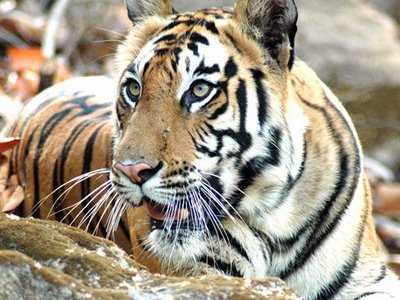 Suddenly she heard a deer and in a fluid movement leapt up and ran to investigate. That’s when I realized that she’d leapt to the left and her leap had carried her a distance further than at which we were standing right in front of her. So if she wished she could have easily leapt into the howdah. What an obituary that would have made – mauled by a tigress while on elephant back!
The next day we took the Corolla into the jungle and Raghu’s darting eyes yielded a wild dog and a baby python. We stopped to observe the snake and it slid under the car in a burst of speed. We waited for it to appear on the other side but 5 minutes passed and there was no sign of it. I got the nauseating feeling that it had managed to slide into the car from the under body. I already started having visions of it sliding up my leg while I was doing 140kph on the Bhopal road when Raghu spotted it sliding away from the same side. It had turned around underneath and retracted.

That day too the mahaouts had spotted tigers the elephant ride took me to four 6-month old cubs.
My last foray into the park was simply the best I’ve ever had at Bandhavgarh. I was the only car into the park that morning and perhaps I’d not slept well that night so I was dozing in the jeep when Raghu suddenly braked hard and jabbed me hard in the ribs. My eyes flew open and there standing on slight rise on the road ahead, nonchalant and secure in the knowledge that he was king and feared, was B2, the most dominant male in Bandhavgarh. He started walking towards us stopping at some trees to mark territory. We kept backing up and he kept walking towards us. For 45 minutes we had him at close quarters. He’d keep cutting into the jungle and returning back to the road. Then he’d just stop and stare at us before starting off again. Believe me, it is not the coat that has given the tiger the adage of burning bright…it is his eyes. When a tiger holds you in its fiery yellow gaze, it caresses your soul with a terrifying warmth, and you feel a mixture of unadulterated fear and holy awe at the magnificence of the striped being that is checking you out.


Finally B2 wandered off into the jungle and we continued onto a place called Amarnalla where two of his cubs were lolling about. The female was jittery at the sight of us and she threw a tantrum, bared her teeth, growled a little and ran off into dense cover. Her brother on the other hand had inherited his father’s eyes and courage and just lay there confident that he could induce more fear in us than we in him.
I returned from Bandhavgarh happy at my sightings and pictures, but sad that slowly and steadily these beautiful cats are fading away.
At Sanchi I took in the peaceful stupa and stared at Ashoka’s emblem, four lions back to back. The symbol of an ancient and powerful dominion that today is on every Indian banknote. But where are the lions? Two thousand years ago in Ashoka’s time they roamed the subcontinent in swarms, but we’ve wiped them out so that now only a few specimens survive claustrophobic and constrained within the Gir National park. Let’s not let that happen with the tiger…
Subscribe to:
Posts (Atom)